

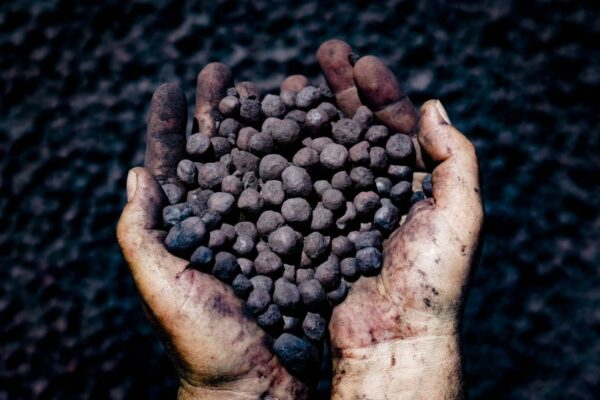
Mineral Description
Iron Ore is one of the most essential industrial minerals globally, serving as the primary raw material for steel production. Iron ore occurs in various forms—hematite, magnetite, limonite and goethite—and its commercial value depends mainly on its iron (Fe) content, impurity levels and physical characteristics.
Types of Iron Ore
- Hematite (Fe₂O₃): high Fe content, reddish tones, widely exported.
- Magnetite (Fe₃O₄): magnetic mineral, suitable for concentration and beneficiation.
- Limonite / Goethite: medium-grade ore with yellow-brown colors.
Industrial Uses and Applications
- Steelmaking: main raw material for blast furnaces and steel plants.
- Foundries: used to manufacture industrial metal components.
- Cement industry: iron corrector in clinker formulation.
- Construction: used to produce beams, rods, sheets and structural alloys.
- Chemical industry: used to produce iron oxides and ferric compounds.
Grades and Fe Content
Commercial iron ore grades include:
- 56–58% Fe
- 58–60% Fe
- 62% Fe (international standard)
- 63%+ Fe
- 65–68% Fe (premium grade)
Extraction and Processing
Iron ore is extracted from open-pit and underground mines. After extraction, the material undergoes crushing, screening, magnetic separation (for magnetite), washing and chemical analysis.
Major producing regions include Australia, Brazil, South Africa, India, Pakistan, Iran and Mauritania.
Iron Ore Supply – PEI PADIMAR
PEI PADIMAR supplies iron ore in lumps, fines, concentrate and pellet feed, with a range of Fe contents adapted to steelmaking, foundries and industrial applications.
Packaging and delivery options include bulk vessels, containers and 1-ton big bags. Full documentation (COA, MSDS, SGS/Intertek analysis and Certificate of Origin) is available.
Short Version for Catalog / WhatsApp
Iron ore (56%–68% Fe) for steelmaking, foundries and industrial applications.