

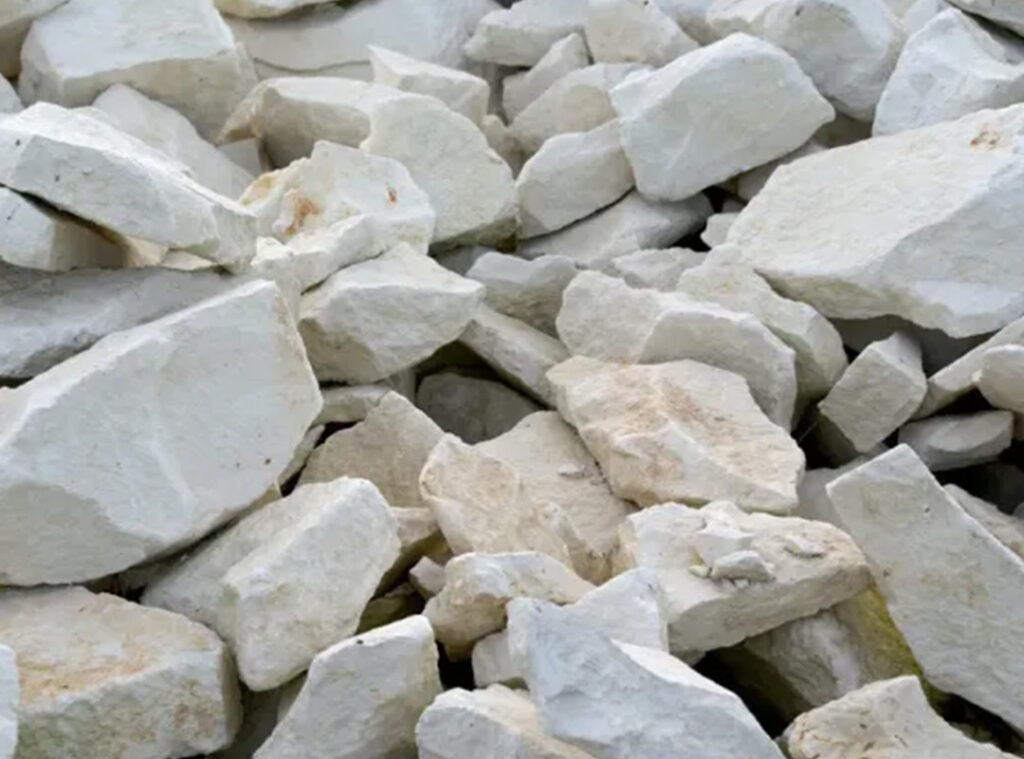
Mineral Description
Limestone is one of the most widely used industrial minerals, composed primarily of calcium carbonate (CaCO₃). It is essential in the cement industry, construction, steel production, agriculture and chemical processes. Limestone typically appears in white, beige or grey tones depending on its purity and geological origin.
Industrial Uses and Applications
- Cement manufacturing: main raw material for clinker and both grey and white cement.
- Construction: used in concrete, road base, aggregates, mortars and prefabricated materials.
- Steelmaking: used as a flux in blast furnaces to remove impurities.
- Chemical industry: raw material for quicklime, hydrated lime and calcium-based compounds.
- Agriculture: soil conditioner and calcium supplement.
- Environmental applications: water treatment and acid neutralization.
Grades and Specifications
Typical CaCO₃ content ranges from:
- 85% – 90% CaCO₃
- 90% – 95% CaCO₃
- 95% – 98% CaCO₃ (high-purity grade)
Extraction and Processing
Limestone is extracted from open-pit quarries and processed through crushing, screening, washing and grinding. Chemical analysis determines CaCO₃, MgO, SiO₂, Fe₂O₃ and moisture levels.
Major producing regions include Pakistan, Spain, Turkey, India, Egypt, Vietnam and China.
Limestone Supply – PEI PADIMAR
PEI PADIMAR supplies limestone in lumps, fines and micronized powder for cement, steelmaking, chemical and agricultural applications. Multiple grades and particle sizes are available.
Packaging options include 1-ton big bags, bulk cargo and containerized shipments with full documentation (COA, MSDS and Certificate of Origin).
Short Version for Catalog / WhatsApp
Limestone (85%–98% CaCO₃) for cement, steelmaking, agriculture and industrial applications.